Inventory is included in the core Resgrid platform and does not require a paid add-on.
What this capability delivers
Designed around the real operational work already managed in Resgrid.
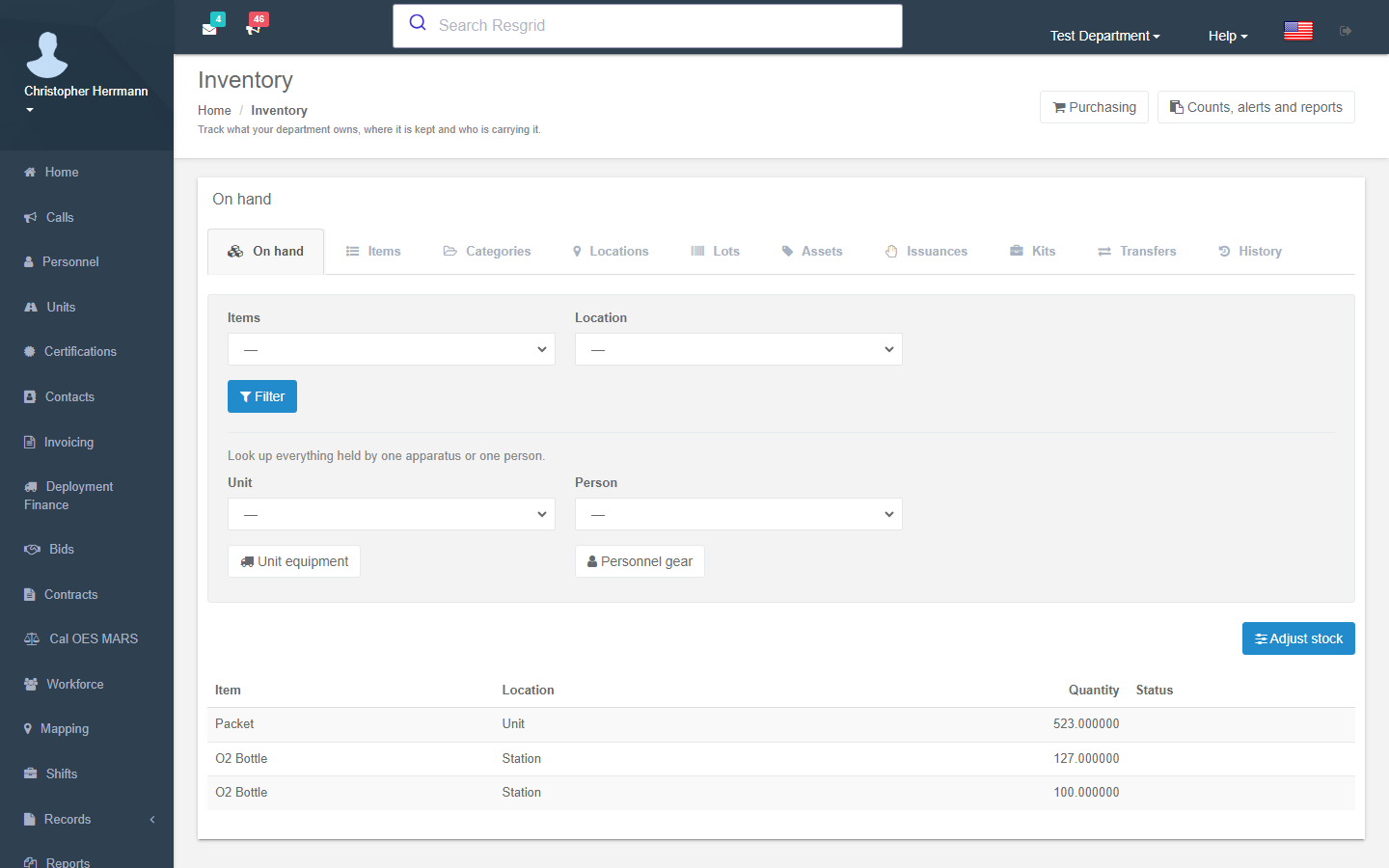
Stock by real location
Track quantities at stations, vehicles, caches, warehouses and temporary incident locations with receive, adjust, consume and transfer transactions.
Serialized assets and barcodes
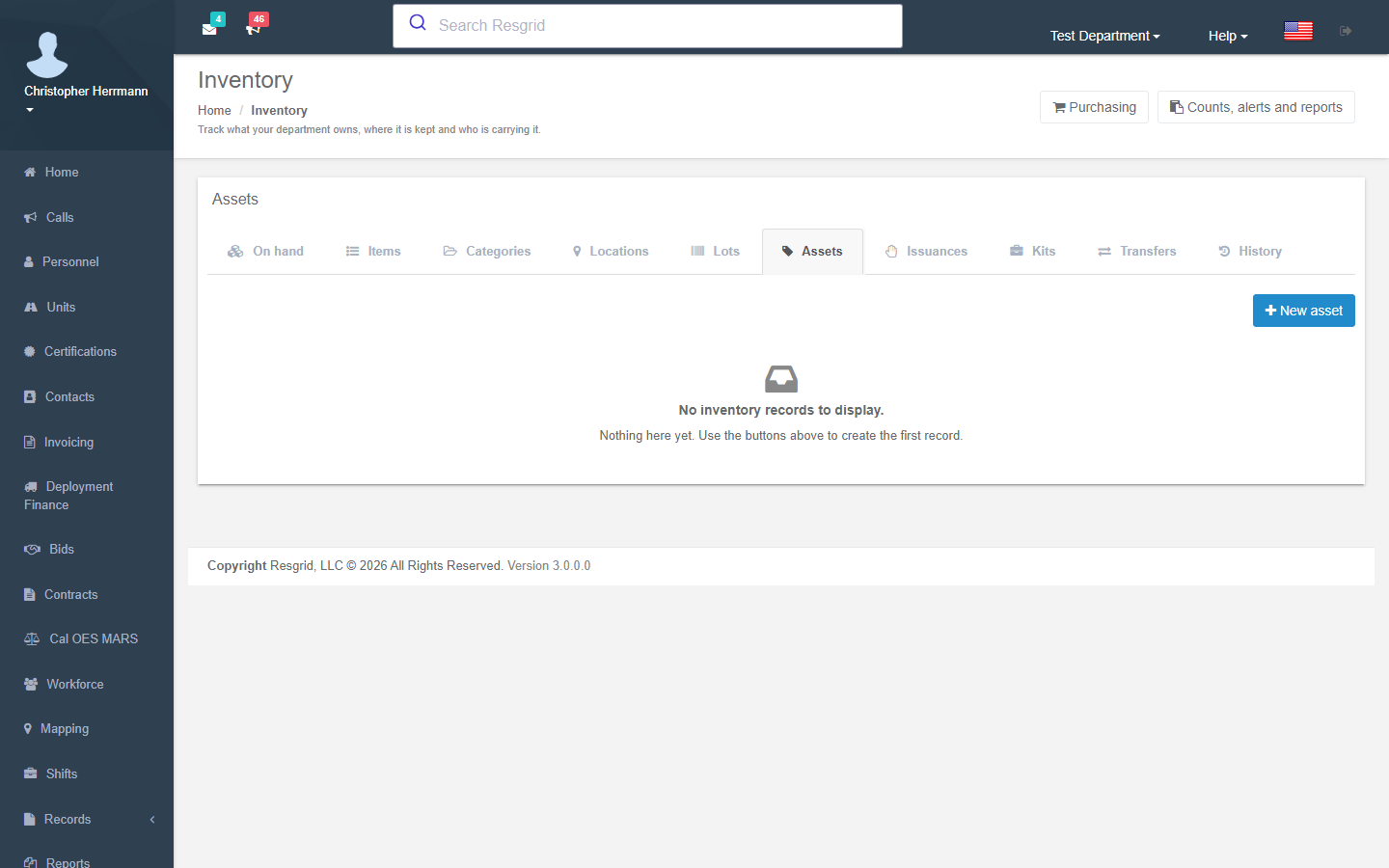
Identify radios, tools, PPE and durable equipment individually, including barcode, status, condition, home location, current holder and service history.
Issue, return and custody
Issue equipment to personnel, units or deployments and preserve an accountable chain of custody through return, damage, loss or reassignment.
Lots, expiry, cost and alerts
Manage expiring lots, low-stock thresholds, controlled items, weighted cost, counts, reconciliation and readiness reporting from one ledger.
How work moves through Resgrid
From the first operational fact to a complete, auditable outcome.
Receive stock into a real location
Receive a shipment into a station, warehouse, cache, vehicle, or temporary incident location. The transaction records quantity, unit, lot or serial details, cost, source, author, and time instead of overwriting an on-hand number.
Identify and place the equipment
Track consumables by quantity or create individual assets for radios, tools, PPE, medical equipment, and other durable items. Barcodes speed identification while typed locations connect equipment to Units, groups, people, and facilities.
Issue, transfer, consume, or deploy it
Move material, issue equipment to personnel or Units, consume supplies on a Call or deployment, or stage it for an incident. Every movement is a ledger entry with its operational source preserved.
Return, inspect, and reconcile
Return issued gear, record loss or damage, perform cycle counts, and reconcile differences through explicit adjustments. Supervisors can see who last held an item and why the balance changed.
Act before a shortage affects readiness
Low-stock, expiring-lot, controlled-item, and custody exceptions feed reports, alerts, and workflows. Purchasing and command staff plan from actual consumption instead of station-by-station estimates.
Technical and operational depth
Designed around lifecycle, authority, evidence and failure modes—not only screens.
Stored balances backed by an immutable transaction ledger
Resgrid will keep fast on-hand balances for operational screens while preserving the transaction history that proves how each balance was produced. Receive, issue, return, transfer, consume, adjust, reserve, release, and count actions append facts instead of rewriting history.
- Department-scoped entries retain item, location, quantity, unit, source, author, timestamp, and correlation
- Stored balances reconcile to the ledger and never become an unexplained standalone number
- Idempotent mobile submissions prevent a retried offline transaction from issuing stock twice
- Counts and adjustments require a reason and preserve expected and observed quantities
- Workflow and audit events are emitted after committed transactions, not uncommitted UI state
Locations that match response operations
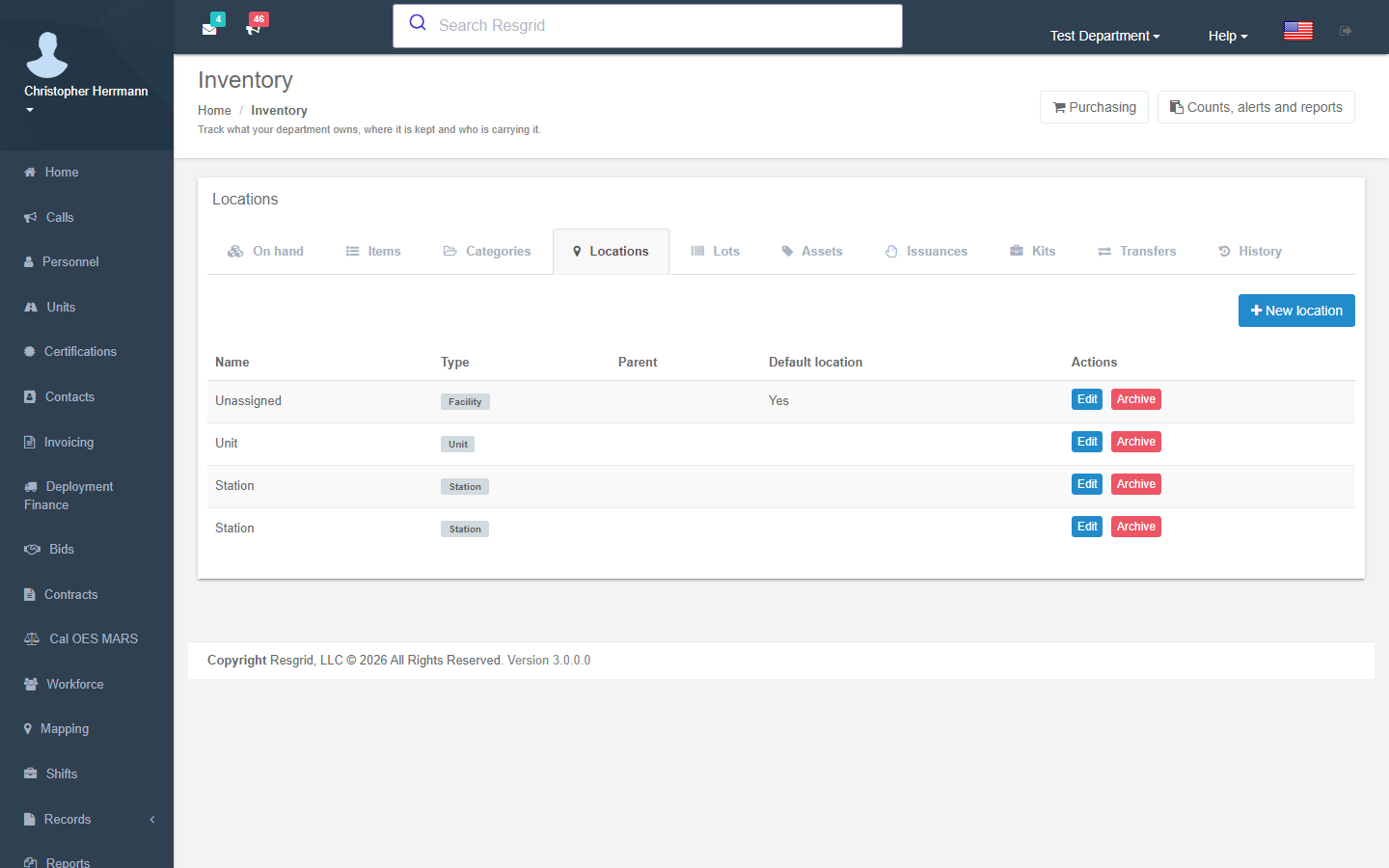
A bin code is not enough when equipment moves between a station, apparatus, responder, warehouse, deployment, and incident cache. Typed locations link those holders without cloning their names into another system.
- Station, warehouse, cache, Unit, personnel, deployment, and temporary incident locations
- Transfers preserve origin, destination, in-transit state, acceptance, and actor
- A serialized asset has one current location and complete movement and custody history
- Issuance supports return-due, condition, damage, loss, and reassignment
- Location-aware permissions prevent all department stock from becoming one unrestricted pool
Consumables, lots, and serialized assets in one model
The same system handles station consumables and individually accountable equipment without pretending they have identical lifecycles. Items choose quantity, lot, or serialized tracking with suitable costing and service behavior.
- Lot and expiry tracking for medical supplies, batteries, food, and other time-sensitive stock
- Serial number, barcode, status, condition, holder, home location, and service history
- Weighted-average costing for ordinary stock and specific identification for serialized assets
- Low-stock, expiry, controlled-item, overdue-return, and reconciliation exception reporting
- Usage hooks for Calls, deployments, maintenance, billing, after-action records, and Incident Back Office
One connected operating picture instead of another data silo
Other options
Generic warehouse tools understand bins and purchase orders but not apparatus, responders, calls or deployments. Spreadsheets are familiar, but simultaneous edits, missing history and manual counts make accountability difficult.
The Resgrid approach
Resgrid treats personnel, Units, Calls, deployments and incidents as native inventory references. Equipment moves with the operation, and every receipt, issue, use, return and adjustment remains traceable.
What this can replace or consolidate
Reduce separate systems without hiding where specialist tools still belong.
Station and vehicle inventory spreadsheets
Replace separately maintained tabs and manual rollups with one location-aware balance and movement history.
Paper PPE and radio issue logs
Preserve custody, condition, return, damage, loss, and reassignment against the actual member or Unit.
Standalone barcode databases
Keep barcode speed while connecting the scanned asset to Calls, crews, Units, maintenance, deployments, and Records.
Light warehouse software
Retire a generic stock tool when operational issuance and incident usage matter more than purchasing-suite complexity.
Built into the Resgrid system
Inventory connects with Units, Personnel, Checklists, Maintenance and Work Orders, deployments, Billing and cost recovery, RMS records, Workflows and reporting. Incident Back Office supply operations is coming soon.
Units
Personnel
Calls & Dispatch
Readiness
Deployments
Records / RMS
Incident Back Office
Billing & Costing
Important scope and system boundaries
Clear limits prevent another vague all-in-one promise.
Inventory is a ledger, not a full ERP
It covers stock, assets, custody, movement, counts, cost, alerts, and operational usage—not a general ledger, accounts payable, procurement approval, or vendor commerce.
Custody records do not replace physical controls
Scanning, issuance, and assignment improve accountability, but locks, controlled storage, access policies, safety inspections, and physical inventory remain organizational responsibilities.
Migration favors traceability over invented history
Existing balances can be imported as controlled opening transactions. Resgrid will not invent receipts, holders, costs, or movements the legacy source cannot prove.
Less duplicate work, more time and budget back
One shared ledger reduces duplicate asset lists, manual reconciliation and emergency searches for equipment while helping departments buy from actual usage, catch shortages earlier and document custody without another system.