Included in the core platform
Records Management System (RMS)
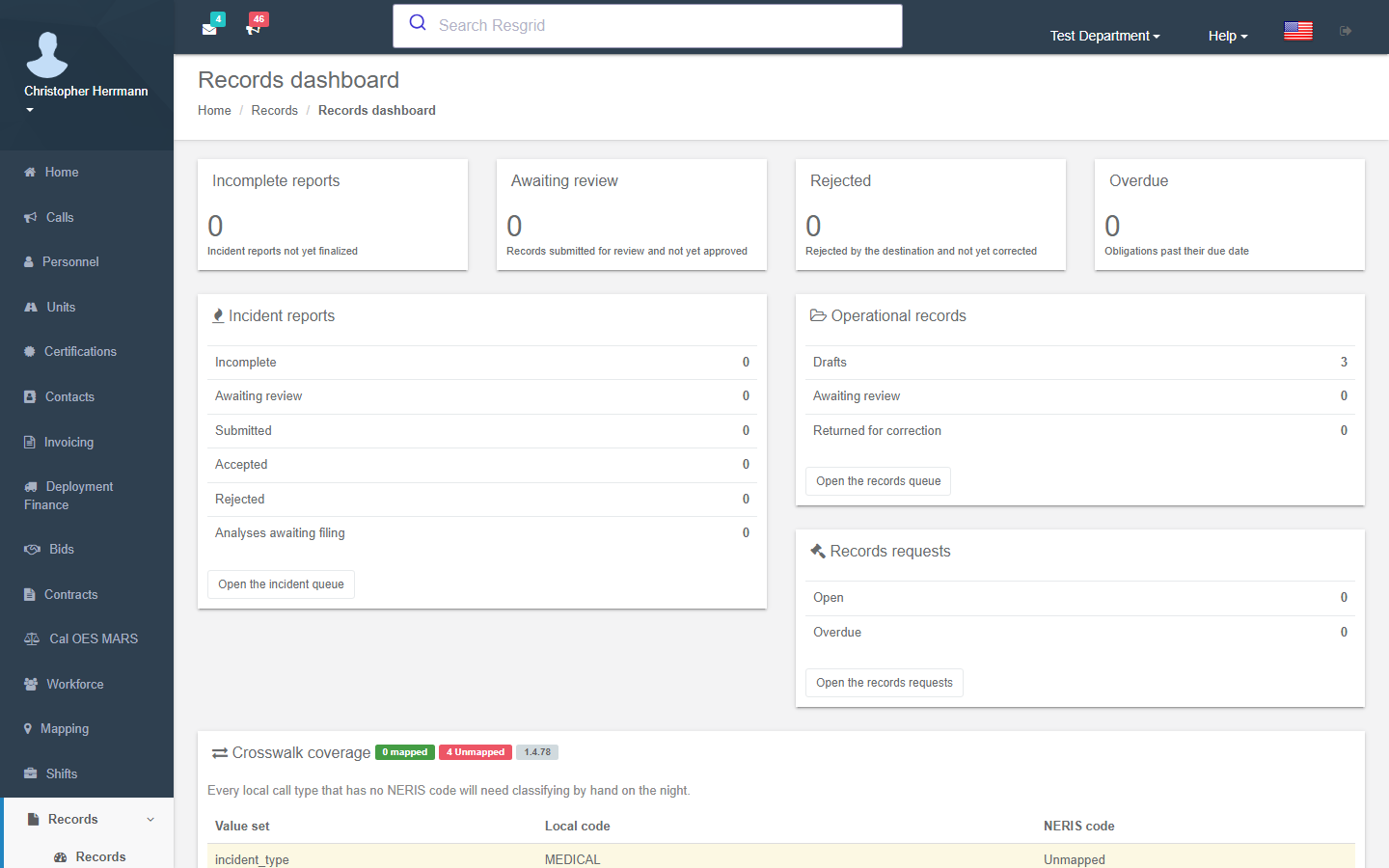
Defensible operational records without re-entering the response. Create, review, finalize, search, print and retain records using the call, units, personnel and incident facts Resgrid already captured during the response.
Included in the core platform
Records/RMS is included in the core Resgrid platform and replaces legacy Logs authoring. It covers operational records and NERIS reporting, not electronic patient care reporting (ePCR).
What this capability delivers
Designed around the real operational work already managed in Resgrid.
Controlled records lifecycle
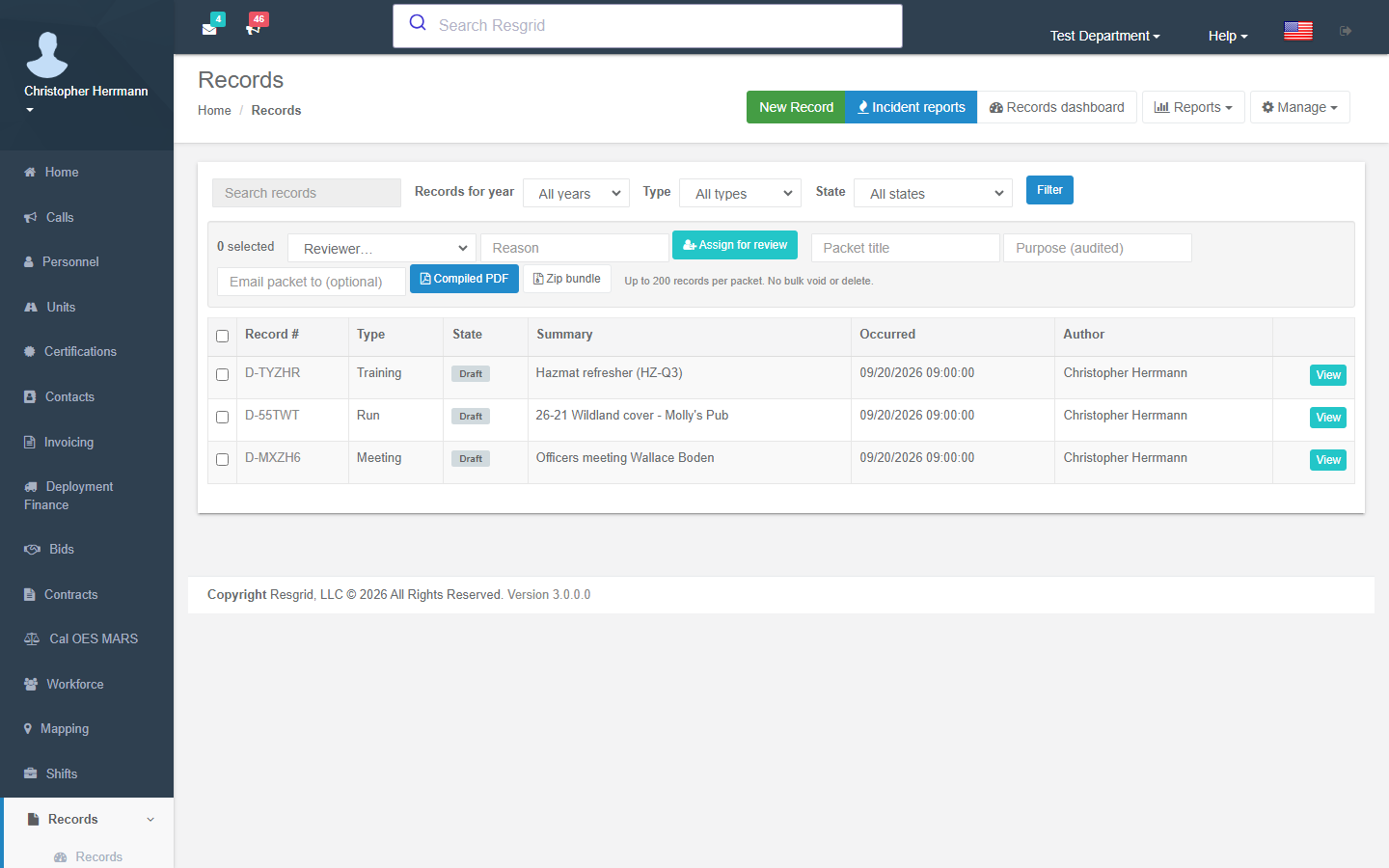
Draft, review, finalize, sign, amend and export records with immutable revisions, validation, permissions, audit history and department-defined retention.
NERIS-first fire reporting
Build U.S. fire incident records against versioned NERIS schemas and value sets with source provenance, validation and an auditable submission workflow.
Field Records
Start and continue approved record types from Responder, Unit, IC and Dispatch applications, including bounded offline work and attachment capture.
Search, disclosure and evidence
Find authorized records, assemble print and export packets, preserve evidence, apply legal holds and manage disclosure without losing revision history.
How work moves through Resgrid
From the first operational fact to a complete, auditable outcome.
Start with facts captured during response
A Call can create the appropriate draft Records with dispatch times, address, Units, staffing, command context, and source identifiers already linked. Record, Call, and external reporting numbers remain distinct and auditable.
Complete the Record from the right application
Authorized users continue the approved Record type from the web application, Responder, Unit, IC, or Dispatch. Field capture can include structured values, narratives, forms, signatures, media, and bounded offline work.
Validate, review, and resolve accountability
Definition rules validate required values and cross-field conditions. Ownership, transfer, duplicate detection, missing-report notifications, supervisory review, and group-scoped access expose incomplete work before finalization.
Finalize an immutable revision
Finalization freezes a version with its definition, values, provenance, signatures, attachments, validation result, and audit context. Later corrections become explicit amendments rather than silent edits.
Search, disclose, retain, and submit
Authorized staff search Records, generate branded print or export packets, apply retention and legal holds, manage disclosure, and submit supported external reports such as NERIS through a traceable workflow.
Technical and operational depth
Designed around lifecycle, authority, evidence and failure modes—not only screens.
A controlled Record lifecycle, not a form folder
The RMS owns draft, review, finalization, signature, amendment, retention, disclosure, and audit semantics. Configurable definitions control capture, but the resulting Record lives inside a governed lifecycle with immutable revisions and explicit authority.
- Multiple approved Record types per Call with separate owner, state, number, and participants
- Draft assignment, transfer, duplicate prevention, overdue reminders, supervisory queues, and bulk packets
- Final revisions preserve definition version, typed values, provenance, signatures, attachments, and validation
- Amendments reference the prior final revision and require reason, author, timestamps, and a new version
- Department retention, legal hold, disclosure workflow, export history, and value-free audit events
NERIS-first fire reporting with source provenance
NERIS reporting is treated as a versioned external contract, not a hard-coded screen. Resgrid maps authoritative operational facts and user answers into the applicable schema and value sets, validates the package, and records each submission response.
- Versioned schema profiles and value sets retain the rules used for a historical Record
- Mapped answers identify whether they came from CAD, Unit activity, staffing, command, a user, or a rule
- Timestamp authority prevents later edits from silently changing an operational source time
- Validation separates blocking errors, warnings, department exceptions, and external failures
- Idempotent submission, retry, receipt, rejection, correction, and resubmission share one audit trail
Search, evidence, printing, and disclosure that survive scrutiny
Records can be found and assembled without bypassing permissions or losing revision context. Search returns authorized content, while print and export render the complete finalized revision—including department fields—under department branding.
- Group-scoped visibility, cross-group sharing, restricted record classes, and field protection boundaries
- Search across identifiers, Calls, locations, people, Units, dates, status, type, and allowed content
- Branded PDF and print layouts include every captured standard and department-defined field
- Disclosure packets retain revisions, redactions, attachments, request history, approvals, and delivery evidence
- Open customer-owned export supports analytics and reduces dependence on a proprietary silo
One connected operating picture instead of another data silo
Other options
A standalone RMS often begins after the call closes, forcing personnel to rebuild the incident from CAD exports, handwritten notes and memory. Generic form builders capture fields but do not own legal record lifecycle or reporting authority.
The Resgrid approach
Resgrid starts the record with authoritative call, timestamp, unit, staffing, location and command context already linked. Users verify and complete the record instead of typing the response a second time.
What this can replace or consolidate
Reduce separate systems without hiding where specialist tools still belong.
The current Resgrid Logs authoring experience
Records is designed to reach Logs parity before the legacy authoring path retires through a controlled cutover.
CAD-to-report re-entry
Stop reconstructing dispatch times, responding Units, staffing, location, and command facts from exports, notes, and memory.
Generic form builders and document folders
Keep configurable capture while adding ownership, review, finalization, amendments, retention, disclosure, and audit.
A separate fire RMS for supported departments
Departments whose reporting scope fits delivered Records and NERIS releases can consolidate operational response and fire records into Resgrid.
Built into the Resgrid system
Records compose safe, versioned facts from Dispatch/CAD, Units, Personnel, Incident Command, Contacts and preplans, Inventory, Checklists, Work Orders, deployments, maps and Workflows while each source remains authoritative. Incident Back Office is coming soon.
Dispatch / CAD
Responder
Unit App
Incident Command
Personnel
Contacts & Preplans
Inventory & Readiness
Workflows & Search
Important scope and system boundaries
Clear limits prevent another vague all-in-one promise.
RMS is not an ePCR replacement at launch
Patient care requires its own clinical, NEMSIS, privacy, and medical-quality lifecycle. Initial RMS covers operational Records and NERIS, not patient care reporting.
Incumbent RMS migration is not promised in the first scope
A vendor-specific historical migration cannot be claimed until source formats, revision fidelity, attachments, identifiers, and legal acceptance are proven.
External reporting follows supported schemas
NERIS submission uses delivered, versioned schemas and validation. Agency-specific exchanges, state overlays, or proprietary gateways require confirmed interfaces before support is claimed.
Less duplicate work, more time and budget back
Departments spend less time reconciling CAD and RMS data, chasing missing reports, rebuilding audit packets and maintaining duplicate rosters, while open exports and self-hosting options reduce lock-in.